Why Every Roller Rink Somehow Plays The Same Tiny Universe Of Songs
The roller-rink canon is not just nostalgia. It is choreography, crowd control, and a shared social script that keeps beginners moving and whole rooms in sync.
Why Every Roller Rink Somehow Plays The Same Tiny Universe Of Songs
The Feeling Of It
Walk into almost any roller rink in America and you can feel the playlist before you hear it.
There is going to be a moment when the floor resets itself around a song everybody somehow knows. A little cluster of kids who were wobbling two minutes ago gets brave. Grown adults start calling out the moves before the chorus lands. Somebody can already sense that Cotton Eye Joe, or Cha Cha Slide, or Cupid Shuffle, or Wobble is coming eventually.
At first that can feel lazy. Why does public skating so often sound like it is trapped in one tiny jukebox universe while the rest of culture mutates every six seconds?
The answer is better than nostalgia. Roller-rink playlist sameness is not just a taste issue. It is infrastructure.
Music Has Always Been Part Of The Equipment
The National Museum of Roller Skating quotes a 1926 rink owner's guide saying that trying to run a rink without music would be about as hopeless as running a restaurant without food.
That line is almost cartoonishly direct, and it matters. Music was never just decoration. It was operational from the start.
You can still see that old logic alive at real rinks. Oaks Park Roller Rink in Portland says it opened on June 23, 1906 and still features a 1926 Wurlitzer pipe organ during select sessions. Its current programming sorts music by use case too, from open skate and adult R&B sessions to specialty nights with live DJs.
A rink playlist is not just a list of songs people like. It is traffic design with bass.
Oaks Park Roller Rink, Portland, Oregon, United States
Oaks Park gives the story a real geography: a rink open since 1906, still programming sessions around specific musical traditions.
Why The Same Songs Refuse To Die
Associated Press reporting on the 2025 Boots on the Ground line-dance boom helps explain why songs like Cupid Shuffle, Cha Cha Slide, Wobble, and Electric Boogie stay in circulation. These are not just hits. They are synchronized, social, learnable-in-real-time tools.
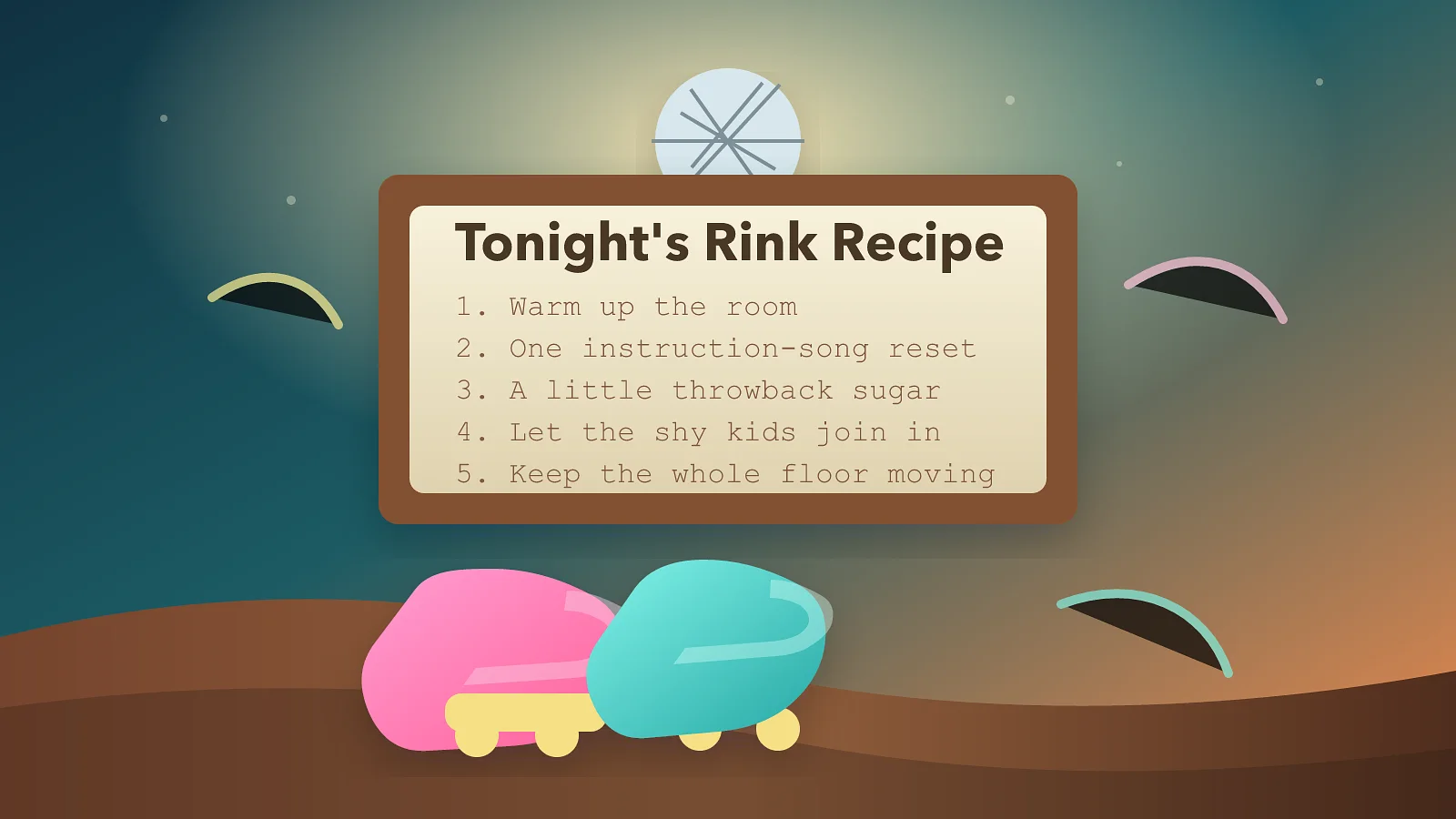
That is why they survive. They reduce uncertainty. They let beginners join quickly without feeling dumb. They give mixed-age sessions a shared script. They let a DJ reset the room and turn a pile of separate people into a temporary organism moving the same direction.
If a song keeps teaching humans how to be in the room together, it does not age the way a normal radio hit ages.
The official <em>Cupid Shuffle</em> video is a clean example of a song that works less like passive listening and more like communal instruction code.
The canonical Spotify version of <em>Cupid Shuffle</em> shows how a single instruction song can function like shared rink software.
A Rink DJ Is Managing More Than Vibes
Rink DJs are not doing the exact same job as club DJs. They are working around speed, floor density, age range, spill risk, attention span, and the general chaos of people on wheels.
The skating outlet RollerSk8r makes the point neatly: a song that works on the radio can fail on the skate floor. Once you think about it, that is obvious. A culturally huge track can still be rhythmically awkward for a room full of people trying not to eat maple.
So the canon persists partly because it is tested. It has a known effect. Staff members know what a familiar instruction song does to the room almost as clearly as the skaters do.
The Playlist Also Reveals Who The Venue Thinks It Is For
Once a public venue starts writing down music rules, it is not only describing sound. It is describing belonging.
Family friendly is one thing. Treating whole genres as inherently suspect, or acting like certain music becomes appropriate only when certain kids are visibly present, is something else. That is not just taste. That is social sorting with a speaker system.
And that matters because some of the strongest skating traditions in the United States are deeply tied to Black social dance, R&B, hip-hop, Southern soul, and regional line-dance cultures. The AP reporting on Boots on the Ground frames line dancing not just as entertainment but as communal joy and shared release. When venues get weirdly broad or coded about whole genres, people notice. They should.
Why The Formula Still Works
Even with all that baggage, there is something beautiful about the survival of the rink songbook.
Roller rinks are one of the last ordinary places where strangers still agree to do the same cheesy thing at the same time in public without needing irony armor. A shared floor needs shared cues. A good rink playlist is not trying to impress you with perfect taste. It is building confidence, timing, and just enough collective silliness to keep the wheels rolling.
That is also why rinks hit people so hard when they disappear. In WUNC's report on Durham's Wheels reopening, artist Dare Coulter said that when rinks close, they usually do not return. The place matters because the ritual matters, and the music is part of that ritual right down to the overplayed songs everybody claims to hate and instantly sings with.
The Slightly Earthy, Slightly Nerd Bottom Line
I went into this expecting a joke about rink playlists being trapped in 1997.
I came out thinking those playlists are a small, resilient piece of social engineering. They are repetitive on purpose. Familiar on purpose. A little corny on purpose. The good ones are not chasing novelty. They are trying to make a room full of humans move together without panic.
Which, honestly, is noble work.
And if that means sacrificing one more evening to Cotton Eye Joe, so be it. Civilization has asked more of us for less.